






A-Level CS NEA: School register system for lower income countries
My A-Level computer science NEA project: School register system for lower income countries.
For my A-Level Computer Science NEA (Non-Exam Assessment), I developed a "School Register System for Lower Income Countries." This project wasn't just about writing code; it was about designing a robust, real-world solution for a specific challenge using the agile software development life cycle (SDLC) methodology.
In this coursework we were tasked with creating a software solution for a client with specific needs. My client was a school in a lower-income country where resources are limited, and traditional paper-based attendance systems are inefficient and error-prone.
The project was inspired by an interview with Jeni, a teacher in Sylhet, Bangladesh. She highlighted how difficult it was to track student attendance accurately. The goal was to create a digital register system that could run on low-specification hardware and provide essential features like attendance tracking, reporting, and SMS notifications to parents.
Technical & Design Highlights:
- Relational Database Architecture: Designed a complex multi-relational SQL database (using Microsoft SQL Server Express) with normalised tables for students, teachers, classes, and attendance records.
- SMS Integration via API: Implemented a system that sends automated SMS notifications to guardians when a student is absent, using JSON, web requests, and the Automate app API to bridge the gap between the PC and mobile networks.
- Object-Oriented Programming (OOP): Built the system in Visual Basic .NET, utilising custom classes and stacks to manage a "layered" console-based Human-Computer Interface (HCI) that is both intuitive and lightweight.
- Security & Validation: Developed custom algorithms for secure rigorous data validation to ensure the integrity of student information.
This project was a deep dive into the full software development life cycle—from initial client requirements and MoSCoW prioritisation to technical design, implementation, and rigorous testing. It proved that even with limited resources, thoughtful software design can significantly improve educational administration and student safety.
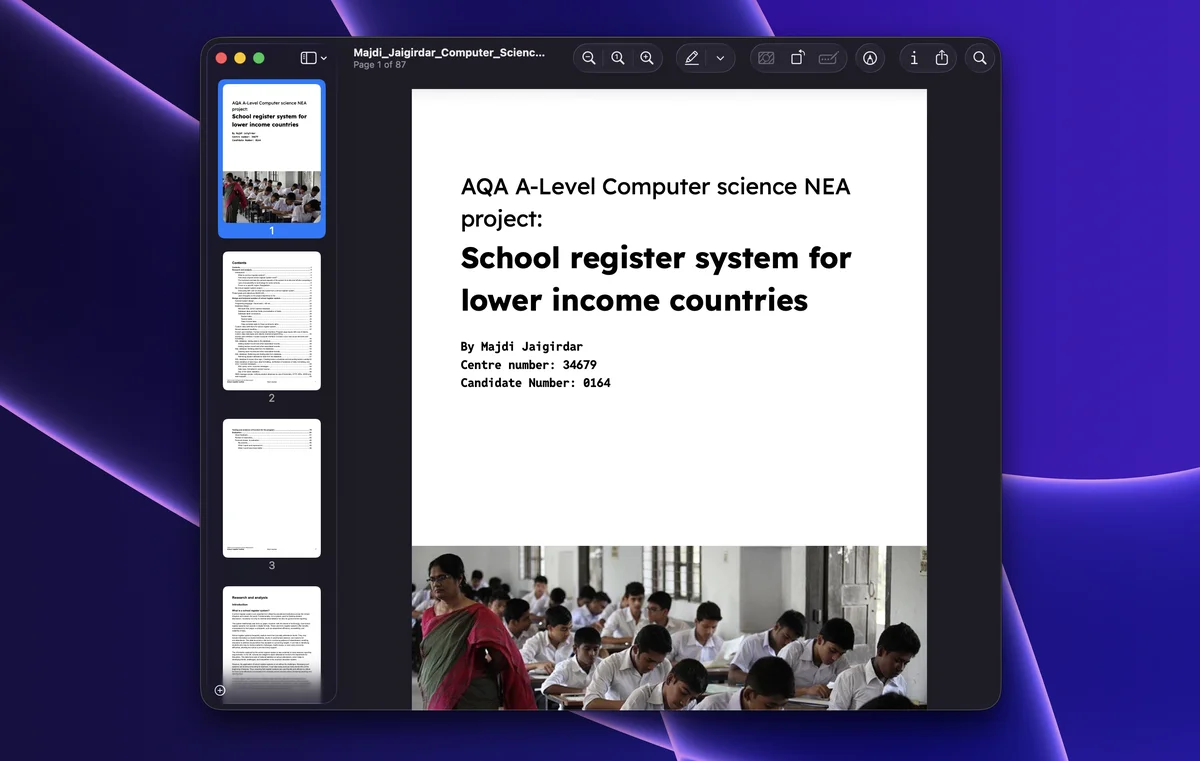
The full technical report and system documentation can be viewed below.
(Note: If the PDF does not display correctly in your browser, you can view or download it directly here
Reflecting on this project, I gained invaluable experience in software engineering principles, but there are many things I would do so differently now having gained more experience in programming and software design in university, and with personal projects.
Looking back at this NEA and more specifically the code I created, I can see many areas for improvement, and somewhat cringe at some of my earlier design decisions. However, it was a crucial learning experience that laid the foundation for my future studies in computer science.
This article reflects the completion of my AQA A-Level Computer Science NEA project. It was originally completed in early 2024 and uploaded to this site on 2025-12-26.